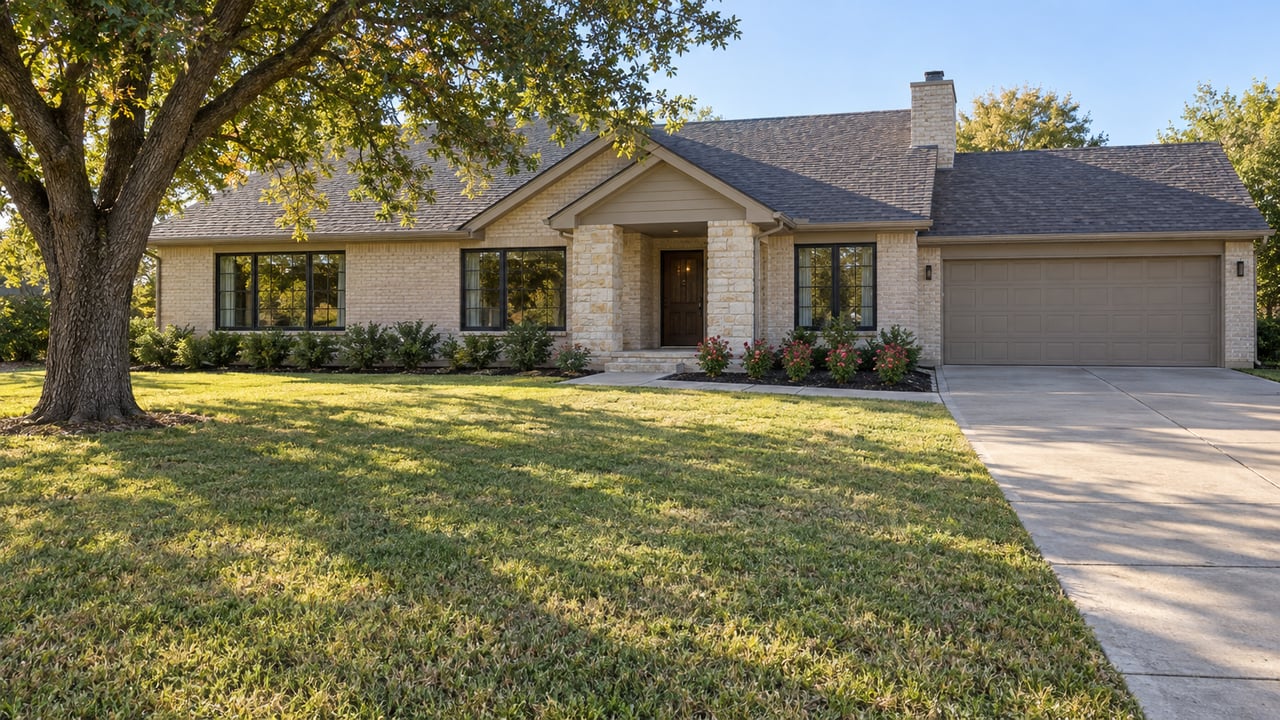
Does a Half-Acre in Dalworthington Gardens Come With Horse and Guest-House Rights?
October 15, 2026
October 15, 2026
Dalworthington Gardens sets its single-family minimum lot size at 21,780 square feet, which is exactly half an acre. That number tells you the lot is large enough for a house. It doesn't tell you whether you can keep horses, chickens or goats on it, put up a barn, or add a guest house. The city's code of ordinances handles each of those uses with a separate threshold, and several of those thresholds sit above the half-acre line. The town also has too few sales to appear in the regional MLS city tables, so comparable sales can't tell a buyer which of these rights a given lot actually carries. That makes the parcel-by-parcel check the most important part of pricing a home here.
If you're close to an offer on a property you've seen on our Dalworthington Gardens neighborhood page, here are the thresholds as the current code states them and the places where they tend to cause trouble during a transaction.
Under Table 14.02.171 of the city code, the SF single-family district requires a minimum lot area of 21,780 square feet. Older lots get some leeway. A lot between 14,500 and 21,780 square feet that was recorded before April 13, 1981 is not treated as nonconforming for lot area. So some homes in town sit on less than half an acre and are still fully legal on lot size.
Each use beyond the house has its own number:
| Use | What the code sets | Where it appears |
|---|---|---|
| Single-family home | 21,780 sq ft minimum lot; pre-April 13, 1981 lots of 14,500 sq ft or more grandfathered | §14.02.171 |
| Agricultural and livestock uses | No such use on a lot under 40,000 sq ft, in districts where the use is otherwise permitted | §14.02.127(a) |
| Grazing density | 10,000 sq ft of grazing area per horse or cow; 3,000 sq ft per other domestic animal | §14.02.127(b) |
| Private stable | Up to four horses, mules or other domestic animals; special exception required | §14.02.092, §14.02.321(c)(12) |
| Accessory dwelling | One per home; the larger of 700 sq ft or 25% of the main home's livable area | §14.02.124(c) |
| Detached accessory building | Permit-exempt only at 300 sq ft or less with no electricity or plumbing | §14.02.124(o) |
A minimum-size lot meets roughly 54 percent of the 40,000-square-foot livestock threshold. The livestock rule also carries a qualifier that matters. Section 14.02.127 applies "in districts where the same are otherwise herein permitted," so it limits where livestock can go and does not grant livestock rights to every residential lot. Whether a particular lot's zoning permits those uses at all is a question for the city, and it should be answered before you settle on an offer price.
Many buyers picture livestock as horses and cattle. Dalworthington Gardens' animal control definitions are broader. Livestock expressly includes chickens, ducks, turkeys, geese, rabbits and goats, along with horses. So a backyard coop falls in the same category as a horse. The code sections we reviewed don't set a separate headcount or setback for poultry. They do prohibit fowl from wandering onto another person's property without consent.
For horses, the grazing ratio is the number to work with. At 10,000 square feet of grazing area per animal, two horses need 20,000 square feet of grazing, which is nearly a full minimum-size lot before the house, driveway and yard take up any of it. Four horses, the maximum a private stable can hold under the code's definition, need 40,000 square feet of grazing area.
The stable has its own requirements. Under §14.02.321(c)(12), a private stable in the SF district is a special exception. It has to qualify as an incidental use, sit on the same or an adjacent property or within 500 feet of the primary residence, belong to the same owner as that residence, and be noncommercial. A special exception is approved for a specific situation. It isn't a general right that comes with the zoning, so a buyer looking at an existing stable would want to know how and when it was authorized.
Buyers often treat an existing barn as proof that a lot allows barns. The code looks at each structure on its own terms. Under §14.02.124, an accessory structure has to be subordinate to the principal structure, can't be used commercially, and can't sit in a required front or side yard, though it may occupy a residential rear yard. Only detached structures of 300 square feet or less with no electricity or plumbing are exempt from building permits. Larger structures, and any attached accessory structure, require a permit and a city inspection.
A residential replat on the city's October 1, 2026 Planning and Zoning agenda shows how this plays out. Staff found multiple structures on the property that conflicted with building setbacks, including a barn and a pig shed. To keep structures inside the setbacks, the owner would need a variance, which requires a public hearing. The packet notes the shed was being revised to comply and the barn would either get a variance request or be relocated. Staff recommended curing any encroachment within a year of replat approval. The structures were already on the ground, and the issue surfaced once the lot went through a formal city review. Any owner who later replats, adds onto the house or pulls a permit could run into the same thing, so a buyer inherits that risk along with the barn.
Fences follow similar limits. Front-yard fences can be up to four feet tall if they don't block sight lines, and no fence or screening device may exceed six feet without prior board approval. A tall fence along the front of a property is another structure worth asking about.
Accessory dwellings are allowed, with conditions. Under §14.02.124(c), a residential lot may have one accessory dwelling per principal dwelling, capped at 700 square feet or 25 percent of the main home's livable floor area, whichever is larger. It needs a permanent foundation, a kitchen and a bathroom, must stay at least 10 feet from other structures, and must meet the principal-structure setbacks. It generally can't sit in front of the main home unless it is more than 100 feet from the front lot line.
The 25 percent figure only matters for larger homes. The two caps meet at a 2,800-square-foot main home, so on anything smaller the limit is 700 square feet. A buyer weighing a modest ranch against a larger move-up home on a similar lot is also weighing how large a guest house each one could support. If an existing guest house is larger than the formula allows, its permit history is the first document to ask for.
Dalworthington Gardens bills residents for water, sewer and garbage and publishes residential sewer rates on its utilities page. Service isn't the same everywhere in town, though. March 2025 council minutes refer to DWG water customers who are on Pantego's sewer system. We didn't find a citywide map showing which addresses connect to which system or whether any homes use septic, so every property needs its own answer.
Sewer capacity along the main commercial corridor is also unresolved. At an August 31, 2026 budget workshop, the council discussed seeking Tarrant County help for a sanitary sewer upsizing project along Bowen Road. County staff later advised that the bond funding guidelines don't cover sewer improvements, so the city withdrew its $170,000 design-funding request and moved the money to the Broadacres Lane Project.
Most buyers price a home from comparable sales. Here, that approach falls short. The August 2026 NTREIS monthly summary only lists cities with at least 10 sales in a property type. Dalworthington Gardens isn't in it. Neighboring Arlington is, and in August 2026 its single-family market recorded 219 sales, a $325,000 median sale price, 45 days on market, 3.2 months of inventory and a $176.28 median price per square foot.
Arlington's numbers describe a high-volume market of mostly standard-size lots. A Dalworthington Gardens sale might involve a grandfathered lot under half an acre, a lot over 40,000 square feet where livestock may be allowed, a permitted guest house, or a barn that needs a variance. Two homes with the same square footage can carry very different rights. A price-per-square-foot figure treats them as interchangeable, which is why our home valuation work here starts with the lot and its permit history.
Property taxes are part of the carrying cost too. The tax-rate ordinance in the city's September 17, 2026 council packet sets $0.680740 per $100 of assessed value for fiscal year 2026–27, split into $0.592139 for maintenance and operations and $0.088601 for debt service. The packet copy's vote fields are blank. The city's 2026 tax rate notice lists that same figure as the voter-approval rate and puts the no-new-revenue rate at $0.645607. The FY 2025–26 rate was $0.625342. Arlington adopted $0.6298 for FY 2026–27 with no change. On $100,000 of assessed value, the city portion comes to about $50.94 more than Arlington's and about $55.40 more than DWG's own rate last year. These figures cover the city levy only, not a full tax bill.
Can I keep chickens on a half-acre lot in Dalworthington Gardens? The code counts chickens as livestock, and it bars agricultural and livestock uses on lots under 40,000 square feet where those uses are otherwise permitted. The city can confirm how that applies to a specific lot and its zoning.
Does an existing barn transfer as a legal structure? It depends on whether it was permitted and whether it meets setbacks. The October 2026 replat case showed that existing structures inside setbacks may need a variance or relocation.
Is every home on city sewer? Not necessarily. Some DWG water customers are served by Pantego's sewer system, so check the specific address.
At LJ Realty Homes, we pull the plat, permit and setback details on a Dalworthington Gardens lot before we discuss price, so you know whether the barn, coop or guest house you're paying for is allowed to stay. Schedule a Consultation and bring the address you're considering.
This article is general information, not legal, tax or financial advice. Consult a qualified professional about your situation.
Stay up to date on the latest real estate trends.
When you work with us, you gain a dedicated professional committed to making your real estate experience smooth, successful, and rewarding.